Royal Rasoi | July 17, 2026


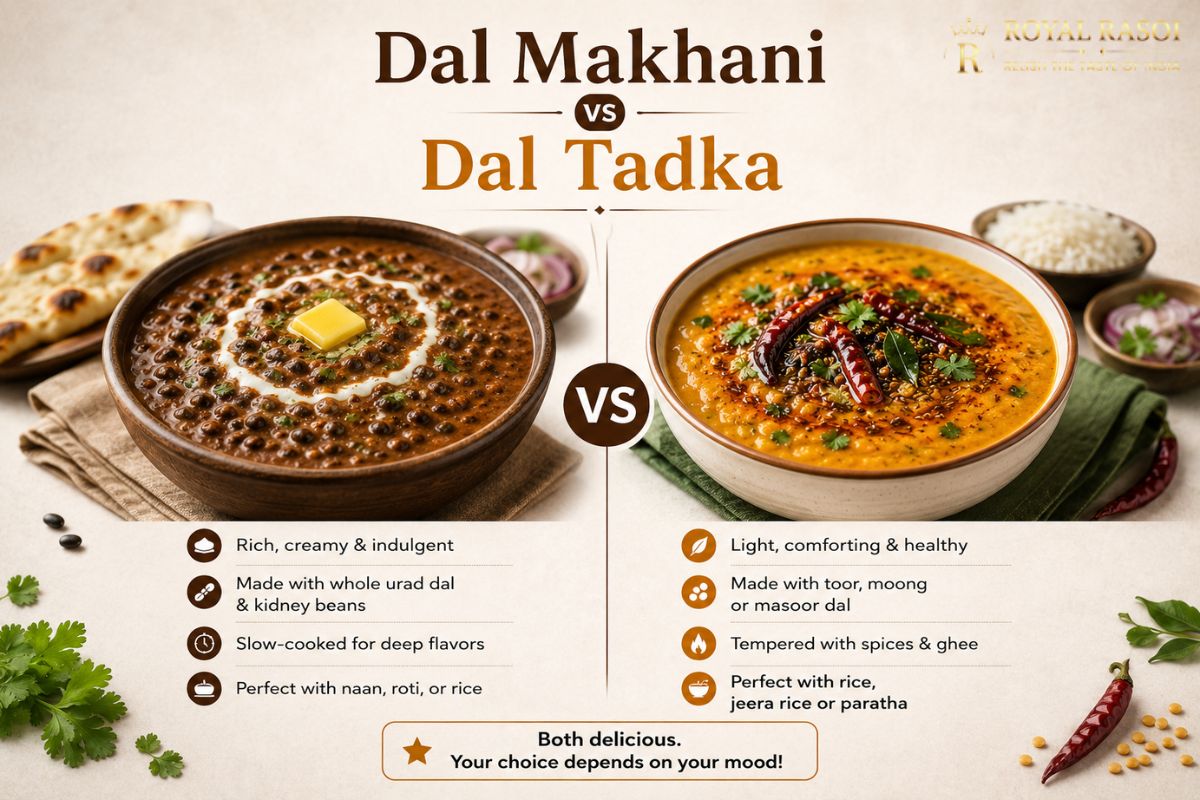
The base of both preparations is lentils, but they diverge instantly from there. Dal makhani uses whole urad dal beans, which sometimes come paired with a few rajma beans. The lentils soak overnight and cook for several hours, turning into a semi-steady state. This is in part because butter is added early in the cooking process while cream is added at the end. The result is a dark, glossy plate that’s almost heavy enough to eat with just naan alongside it.
Moreover, dal tadka, in contrast, uses split yellow lentils that take about twenty to thirty minutes to cook. Most of the flavor comes from the tadka, which consists of cumin seeds, garlic, dried red chili, and occasionally asafoetida, all heated in ghee and placed over the lentils right before serving. The dish is much lighter and doesn’t leave the feeling of heaviness behind when eaten.
| Feature | Dal Makhani | Dal Tadka |
|---|---|---|
| Main lentil | Whole black urad, sometimes kidney beans | Split yellow toor or moong |
| Cooking time | 3–8 hours (traditionally overnight) | 20–30 minutes |
| Texture | Thick, creamy, almost stew-like | Thin, soupy |
| Fat used | Butter and cream | Ghee or oil, used sparingly |
| Typical meal role | Special occasion or indulgent dinner | Everyday home-style meal |
| Calorie density | Higher | Lower |
It's not the spice blend doing the work. It's time and dairy. Black urad releases a natural stickiness the longer it cooks, which is why a version simmered overnight tastes different from one rushed through in two hours. Butter goes in at intervals instead of all at once, and the cream is stirred in right before the dish leaves the kitchen so it doesn't split.
However, that's also why quality swings so much between kitchens. A rushed dal makhani tastes thin and grainy. A properly made one has a body you can feel on the spoon. If you're trying to judge the best Dal Makhani in Hanoi, check the texture before you even taste it. It should hold its shape slightly when scooped, not run like soup.
Dal tadka isn't trying to impress anyone. It's what most Indian families cook on a random Tuesday because it's fast, cheap, and forgiving. Lentils, turmeric, and salt get you most of the way there, and the tadka finishes it off with whatever's on hand.
Because it uses less fat, it also holds up better as a takeaway order. It doesn't separate or turn heavy the way a cream-based dish sometimes does after sitting in a container for twenty minutes. For vegetarians eating Indian food a few times a week, this tends to be the default dal, with dal makhani kept for when something more special is called for.
Lentils are one of the better plant-based protein sources around, and that's true for both dishes. Cooked lentils generally provide about 9 grams of protein and roughly 8 grams of fiber per 100 grams, plus meaningful iron and folate. That baseline barely shifts between urad and toor dal. The nutritional gap between dal makhani and dal tadka comes almost entirely from what gets added afterward.
Therefore, butter and cream push dal makhani's fat and calorie count well past dal tadka's. A restaurant portion of dal makhani can carry two to three times the fat of an equivalent portion of dal tadka, purely because of the dairy. Neither dish is bad for you. It comes down to whether you want your protein with extra richness attached or without it.
Vegetarians watching cholesterol or calories often stick to dal tadka day to day and treat dal makhani as an occasional order. Best Indian food in Cau Giay serves the best dishes.
Hanoi's Indian food scene has grown enough that finding solid vegetarian options no longer means settling for a bland paneer dish and moving on. The better kitchens cook dal the traditional way, meaning real simmering time for dal makhani instead of a shortcut version thickened with flour.
When you're comparing the best Indian vegetarian restaurants in Hanoi, look past the menu length. Check whether they use ghee or butter rather than a generic vegetable oil substitute, whether the dal shows visible texture instead of looking uniformly smooth, and whether the kitchen actually specializes in North Indian cooking rather than treating dal as an afterthought next to the curries. Royal Rasoi builds its dal makhani around a long, slow cook instead of speeding it up for faster turnaround, and that's usually what stands out on a first visit.
Cau Giay has turned into one of the more dependable areas in Hanoi for a sit-down Indian meal, partly because of the number of expats and students in the district who eat Indian food often enough to demand consistency. If you're searching for the best Indian food in Cau Giay, the gap between an average spot and a good one usually comes down to basics: fresh naan made to order, dal that hasn't been sitting since morning, rice that's actually fluffed instead of clumped.
Furthermore, anyone specifically hunting for a best vegetarian Indian restaurant in Cau Giay will notice that Royal Rasoi keeps its vegetarian menu separate enough from the meat dishes that cross-contamination isn't a concern, something that matters more to strict vegetarians than most restaurants seem to realize. The dal makhani there is cooked fresh daily instead of made in bulk and reheated, so it tastes about the same whether you go on a Monday or a Saturday.
People new to Indian food make a few predictable errors. The first is assuming dal makhani and dal tadka are interchangeable because they're both "dal." They're not, and ordering the wrong one for your mood is the fastest way to end up disappointed. Wanting something light and getting a bowl of dal makhani instead feels heavier than expected.
The second mistake is writing off dal tadka as bland because it looks plain. A well-tempered dal tadka carries more flavor than its appearance suggests. Judging it by color undersells it.
The third is expecting dal makhani to taste the same everywhere. Because the dish depends so heavily on cooking time, the same name on two different menus can produce two very different bowls. That's exactly why a specific restaurant's reputation matters more with dal makhani than with most other dishes.
Eating alone and wanting something filled with bread? Dal makhani with naan gets close to a full meal on its own. Ordering as part of a bigger spread with rice, curry, and vegetables? Dal tadka fits better since it won't compete with the richness of everything else on the table.
Therefore, for vegetarians new to Indian food, ordering from both the first time and splitting them works well. You'll get a clearer read on which style you actually prefer instead of guessing from a menu description. Restaurants that offer half portions make this easier, and it's worth asking even when it's not listed on the menu.
Neither dal makhani nor dal tadka wins outright. They do different jobs at the same table. Dal makhani is what you order for comfort food that fills you up. Dal tadka is what you order for something dependable that won't sit heavy. Both are meat-free, both hold their own nutritionally, and both are worth ordering at least once.
If you're in Hanoi and want to taste the difference for yourself, Royal Rasoi makes both the traditional way, with the best Dal Makhani in Hanoi simmered for hours instead of rushed. Stop by in Cau Giay and compare them side by side.
Reserve your table at Royal Rasoi and experience the finest Indian cuisine in Hanoi with family, friends, or colleagues.
 Book Your Table