Royal Rasoi | July 17, 2026


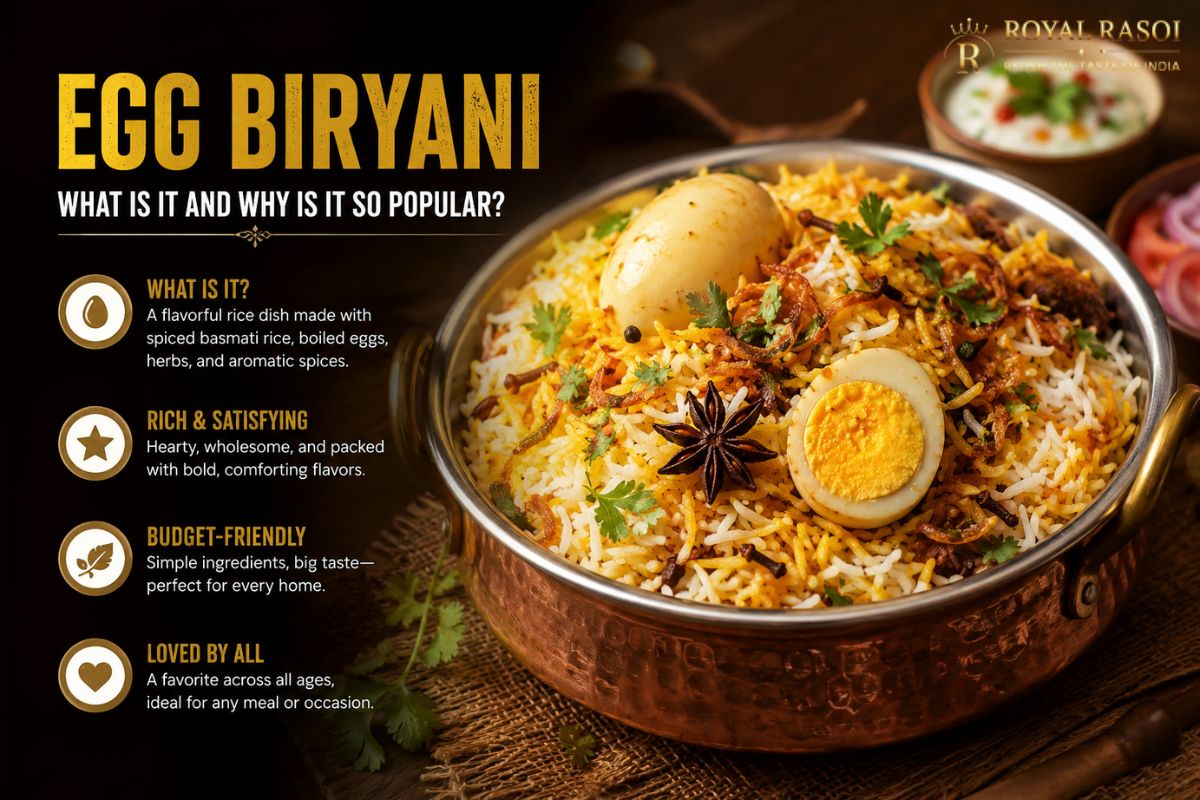
Egg biryani involves layering rice with boiled and fried eggs as well as the onion and tomato masala, then sealing and cooking using the strategy of dum. The importance of the sealing step is that it creates an enclosed environment in which the smell from the spices and the fried onions can permeate and flavor the rice cooking in that environment.
Though it is often described as "biryani with eggs added in," it is not exactly true – the eggs are seasoned separately and sometimes made to blister by being shallow-fried, after which they can be layered properly, preserving their texture.
When compared to chicken biryani or mutton biryani, egg biryani seems lighter when eaten because cooking eggs doesn't release the fat and connective tissue from meat, and hence affects how the spices combine with the rice - it makes the dish a bit drier since it is not greasy enough.
However, another reason behind the popularity of egg biryani is the time factor and the fact that meat needs to marinate for a long time and has to cook evenly at a low temperature, while eggs, be it boiled or fried, are ready instantly.
Price is undoubtedly the main reason. Eggs are cheaper than many meats, making egg biryani economical on the menu, without skimping on rice or spices.
Additionally, equally important is flexibility. While many of the diners at Indian restaurants don’t consume meat due to religious, health, or personal reasons, they do use eggs- making egg biryani a middle dish, not quite vegetarian or meat biryani. Last but not least, you will be pleased to know that egg retains its taste when reheated, unlike many kinds of meat.
If it’s your first time looking at the menu of an Indian restaurant in Hanoi, egg biryani will be your most appropriate choice- it is a dish you feel comfortable eating, yet exotic enough to help you feel like you are in India.
The eggs get top billing, but honestly the flavor comes from everything around them:
Cut corners on the fried onions or use cheap rice, and the whole dish tastes flat no matter how good the masala is.
It comes down to four stages: boil and season the eggs, par-cook the rice with whole spices, build the onion-tomato masala, then layer everything and seal the pot for dum.
Dum cooking means sealing the pot- traditionally with a rope of dough pressed around the lid- so the steam and aroma have nowhere to go but into the rice while it finishes on very low heat. Skip this step, and you end up with rice that's evenly spiced-looking but tastes thinner, without that trapped, layered smell biryani is supposed to have.
Egg biryani changes a lot depending on where you order it:
Moreover, that difference matters because it sets your expectations before the plate even arrives. A North Indian restaurant in Hanoi is more likely to serve something closer to the Lucknowi or Punjabi end of the spectrum- milder, more aromatic, less chili-forward than what you'd get from a South Indian kitchen.
This trips people up constantly. Egg biryani is not vegetarian in the traditional Indian sense- most Indian kitchens and menus classify eggs separately from vegetarian food, full stop.
It does fall under "eggetarian" or ovo-vegetarian, meaning it works for anyone who eats eggs but skips meat, fish, and poultry. Most restaurants label it clearly enough that this shouldn't be a surprise at the table, but it's worth asking if the menu is vague. The best Indian restaurants in Hanoi will serve the delicious biriyani.
Good egg biryani has separate, fluffy grains- not clumped, not mushy with a light orange-brown tint from the masala rather than the flat, uniform yellow that comes from food coloring. The eggs should still hold their shape and not turn rubbery, which usually just means they were boiled right before going in.
Aroma tells you almost as much as taste does. If you can pick out cinnamon or star anise the second it's set down in front of you, that's dum cooking done properly, not a shortcut.
Even restaurant kitchens mess this up more than you'd think:
Therefore, any single one of these can flatten an otherwise decent biryani, even when every ingredient on the list is correct.
It's meant to be served hot, straight out of the sealed pot, next to something cooling like raita - yogurt with cucumber or onion and a plain salad. Some regions pair it with a light gravy called mirchi ka salan, though that's more of a meat-biryani tradition.
Furthermore, eggs get halved or quartered on the plate so the yolk color shows against the rice. Small detail, but it's usually a decent sign the eggs were cooked fresh rather than sitting around.
Hanoi's Indian food scene has picked up noticeably over the past few years, and egg biryani is now a fixture on most menus across the city. If you're looking for the best Indian restaurants in Hanoi that actually get the eggs right, watch for places that season and layer them separately instead of tossing them straight into cooked rice- that one detail says a lot about how seriously the kitchen takes technique.
Location plays a role too. Anyone hunting for the best Indian food in Cau Giay will find a growing pocket of Indian kitchens there, several run by chefs trained in specific regional styles rather than working off a generic recipe. When you're comparing the best Indian restaurants in Hanoi, check whether the kitchen actually uses whole spices and slow dum cooking- you can usually tell from the smell and the rice texture before you even taste it.
For a sit-down meal, Royal Rasoi makes its egg biryani with traditional dum cooking and a whole-spice masala base rather than cutting corners, which makes it a solid stop if you're after the real thing in the city.
Egg biryani earns its popularity the straightforward way- it's cheap, quick, and flexible enough to work for a lot of different eaters without giving up the spice and aroma that make biryani worth ordering in the first place. Get the basics right- good rice, properly seasoned eggs, patient dum cooking- and the rest mostly takes care of itself.
Whether you're making it at home or ordering it out, knowing what separates a good version from a mediocre one changes how you eat it. You start noticing the aroma before the first bite instead of after.
Reserve your table at Royal Rasoi and experience the finest Indian cuisine in Hanoi with family, friends, or colleagues.
 Book Your Table